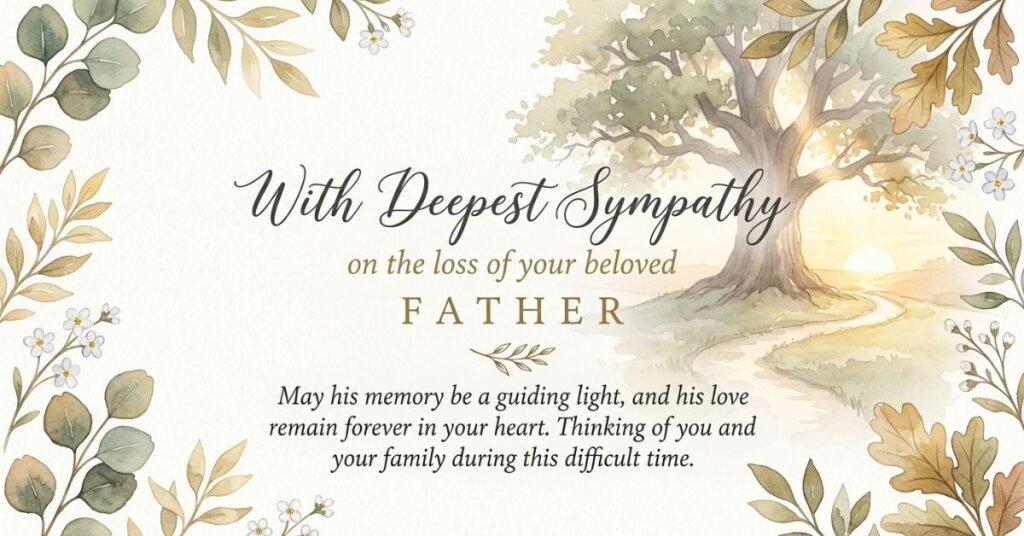
A father is rarely just one person in a family. He is the voice that gave advice nobody asked for, the hand that held a bicycle seat steady, the quiet presence at the back of a graduation hall, the name on the family tree that everyone else’s names grow from. When he dies, the people who loved him lose far more than a relative. They lose a whole way of being known.
If someone you care about has just lost their father, you may feel stuck between wanting to help and fearing you will say the wrong thing. This guide is written to remove that fear. Inside you will find original condolence messages for dozens of situations, a plain-language explanation of what grief after a father’s death actually feels like, practical dos and don’ts, and ways to support a grieving person long after the funeral flowers have faded.
Key Takeaways
- Showing up matters more than sounding perfect. A short, sincere message sent early is worth more than a polished one sent late.
- Keep it simple. Acknowledge the loss, name the father if you can, and offer something specific. Three or four sentences are enough.
- Personal memories are the most treasured gift. One small story about the father can bring the grieving person comfort for years.
- Avoid trying to explain or fix the loss. Phrases that start with “At least…” or “He’s in a better place” can feel dismissive, even when they are well meant.
- Match your tone to your relationship. A message to a boss, a best friend, and a grieving cousin should each sound different.
- Match your words to their beliefs. Use faith-based language only when you are sure it fits the person.
- Grief has no deadline. The first weeks are loud, but the months after are often the loneliest. Follow-up messages are deeply appreciated.
- Pair words with action. Bringing food, handling an errand, or simply sitting with someone can say what language cannot.
- You do not need to expect a reply. Tell the person they do not have to respond. It lifts a burden from them.
Quick Reference Table: Choosing the Right Message
| Your Relationship | Best Tone | Ideal Length | Best Format | Example Opening |
|---|---|---|---|---|
| Close friend | Warm, personal, informal | 3–6 sentences | Text, call, handwritten card | “I’m so sorry about your dad. I’m here, whatever you need.” |
| Family member | Tender, shared memories | 4–8 sentences | Card, call, in person | “Uncle meant the world to all of us.” |
| Colleague | Respectful, gentle | 2–4 sentences | Email, card, workplace message | “I was very sorry to hear about your father’s passing.” |
| Boss or manager | Formal but human | 2–4 sentences | Email or card | “Please accept my deepest sympathies on the loss of your father.” |
| Employee or team member | Caring, flexible | 3–5 sentences | Email, private message | “Please take all the time you need. We have things covered.” |
| Acquaintance or neighbor | Brief and kind | 1–3 sentences | Card, short text | “Thinking of you and your family at this difficult time.” |
| Someone who has also lost a father | Empathetic, honest | 4–7 sentences | Call, handwritten note | “I know a little of what this feels like, and I’m here.” |
| Religious community member | Faith-aligned, consoling | 2–5 sentences | Card, message, prayer | “May he rest in peace and may you find comfort.” |
| Social media (public post) | Respectful, restrained | 1–2 sentences | Comment or reply | “Sending love and strength to you and your family.” |
Understanding What Losing a Father Feels Like
Before choosing words, it helps to understand what the grieving person might be carrying. Not every person will feel the same things, but several themes appear again and again when people describe losing a father.
The Loss of a Protector, Real or Symbolic
Even adults with families of their own often describe their father as a kind of safety net. Whether he was strict, gentle, distant, or deeply involved, his existence offered a sense that someone older and steadier was still in the world. When he dies, many people suddenly feel they have stepped into the front line of life.
Grief for the Relationship That Was and the One That Wasn’t
Some fathers were close, funny, and endlessly present. Others were quiet, strict, or emotionally unavailable. A person mourning a complicated father may grieve not only the man, but also the conversations they never had and the reconciliation that never came. Your message should leave room for all of these possibilities. Avoid assuming the relationship was perfect.
Practical Pressure on Top of Emotional Pain
The days after a father’s death are often filled with decisions: funeral arrangements, paperwork, family gatherings, finances, and the care of a surviving parent. Grief is rarely given quiet space to be felt. This is why messages that say “don’t worry about replying” and offers like “I’ll handle dinner Thursday” are so valuable.
Grief Arrives in Waves
Grief is not a straight line from sadness to healing. It tends to come in waves. A person may laugh at lunch and break down in the car. A smell, a song, a tool in the garage, or a handwriting sample can reopen everything. Knowing this helps you understand why a single message may not be enough, and why checking in later matters.
The Sudden vs. Expected Loss
A sudden death can leave shock, disbelief, and unanswered questions. A death after a long illness may bring relief mixed with guilt, exhaustion, and a deep tiredness. Neither is easier. Both deserve gentle language that does not rank one kind of pain above another.
Before You Write: A Simple Framework
When you sit down to compose a message, you can follow a small four-part structure. You do not need all four parts every time, but together they create a message that feels complete.
- Acknowledge the loss. Say plainly that you are sorry. Avoid hiding behind vague phrases.
- Name or remember him. Use the father’s name or title (“your dad”, “Mr. Rahman”, “Uncle Tariq”). Add a short memory or quality if you have one.
- Say something about the grieving person. Recognize their pain, their strength, or the love they gave him.
- Offer presence. Offer something specific, or simply promise to stay close.
Example using all four parts:
“I’m so sorry about your father. I’ll always remember how he’d greet everyone at your door like they were family, and how proud he was every time you spoke. You were so devoted to him, and I know this hurts deeply. I’m bringing dinner over on Wednesday, no need to answer, just leave the porch light on.”
Short Condolence Messages for the Loss of a Father
Short messages are ideal for text messages, quick cards, and situations where you want to be sincere without overwhelming the person.

- I’m so sorry for the loss of your father. You and your family are in my thoughts.
- Holding you close in my heart today. Your dad will be deeply missed.
- Heartfelt condolences on your father’s passing. I’m here for you.
- There are no perfect words, but please know you’re loved and supported.
- Wishing you comfort and strength as you say goodbye to your dad.
- Your father’s kindness lives on in you. Thinking of you with so much care.
- I was heartbroken to hear the news. Please lean on me.
- May the love of those around you carry you through this season.
- Sending a quiet, steady hug your way. No reply needed.
- Your dad was a good man. I’m so sorry he’s gone.
- With deepest sympathy to you and your family.
- May his memory be a source of strength in the days ahead.
Heartfelt and Long Condolence Messages
Use these when the relationship is close and you want to express more than a few lines.
Message 1: For a close friend
I’ve been thinking of you nonstop since I heard about your dad. I know how much he shaped who you are. The way you care for people, the way you show up, all of that has his fingerprints on it. I can’t take the pain away, but I can sit beside you in it. Whether you want to talk, cry, be silent, or be distracted with a ridiculous movie, I’m here. You don’t have to be okay for me.
Message 2: For someone who was very close to their father
The bond you shared with your father was something people admired from the outside. You didn’t just love him, you truly liked him, and he clearly felt the same about you. Losing someone like that leaves a quiet that nothing fills quickly. Please be gentle with yourself in the weeks to come. Grief this deep is simply love with nowhere to go. I’ll be nearby for as long as you need.
Message 3: For a family member
Our family has lost one of its anchors. Uncle was the one who made every gathering feel like home, who told the same stories every Eid and somehow made them funnier each time. I will miss his voice, his laugh, and his stubborn generosity. I’m holding you and your mother and siblings in my prayers, and I’m only a phone call away, any hour.
Message 4: When you know the father personally
I still remember the afternoon your dad fixed my bicycle chain without being asked and then refused to take thanks for it. That was the kind of man he was: quietly generous, never seeking credit. The world feels a little emptier without him. I’m so sorry for your loss, and I’m grateful I got to know him.
Message 5: Reflecting on a legacy
A man’s legacy isn’t only what he built, it’s who he raised. Your father’s patience, humor, and integrity are alive in every conversation I have with you. He is not gone from the world while you are in it. I’m holding you with great love today.
Message 6: For someone far away
I wish I could be beside you right now instead of sending this from miles away. Distance feels cruel at moments like this. Please know that I’m with you in spirit, and I’ll call whenever you want a voice at the other end of the line, whether it’s midnight or midday.
Condolence Messages for a Friend
Friendship allows for honesty, warmth, and sometimes even gentle humor. Keep your friend’s personality in mind.

- “I’m so sorry about your dad. I’m coming over later. You don’t have to host me, just let me sit with you.”
- “Your dad was proud of you in ways you probably never fully heard. I hope you can feel it now.”
- “I can’t imagine how heavy this feels. Whatever you need, practical, emotional, or just company, I’m yours.”
- “No pressure to answer messages. I’ll check in anyway. Consider this a standing hug.”
- “He raised a remarkable person. I’m grateful for him, and I’m so sorry he’s gone.”
- “If tonight is a rough one, call me. I don’t care what time it is.”
- “I’m cooking for your family this week. Tell me what everyone hates, and I’ll handle the rest.”
- “I keep remembering how loud he laughed at his own jokes. I hope you’re hearing that laugh in your memory today.”
Condolence Messages for a Colleague or Coworker
Workplace messages should be warm but respectful of boundaries. Avoid prying into details.
Email to a colleague
Subject: Thinking of you
Dear Sara,
I was very sorry to hear about the passing of your father. Please accept my sincere condolences. Please don’t worry about work for now, the team will cover everything. If there is anything I can help with, even something small, just ask.
With warm thoughts, Ali
Short card message
Our whole team is thinking of you and your family. Take all the time you need. We’re here whenever you’re ready.
For a colleague you barely know
I’m sorry for the loss of your father. Please know you have the support of everyone here.
For a team member (from a manager)
I was truly saddened to learn of your father’s passing. Please take as much time as you need. Your workload will be taken care of, and your only job right now is to be with your family. Reach out to me if there’s anything at all that would make this easier.
From a team, as a group message
From all of us at the office: we’re heartbroken for you. We’re sending warmth, flowers, and the promise that your desk will be exactly as you left it whenever you return.
Condolence Messages for a Boss or Senior
Respectful, simple, and sincere. Avoid overly casual phrases.
- “Please accept my deepest sympathies on the loss of your father. You and your family are in my thoughts.”
- “Our team joins me in sending heartfelt condolences. Please take all the time you need, we have everything in hand.”
- “I’m truly sorry for your loss. Your father must have been a remarkable person to have raised a leader like you.”
- “May you and your family find strength and peace in the days ahead. With sincere sympathy.”
Condolence Messages for a Daughter Who Lost Her Father
The father-daughter bond has its own tenderness. These messages acknowledge that.

- “A daughter’s first hero never really leaves. He lives in your voice, your choices, and the way you love.”
- “I know you were his pride and joy. He told everyone about you, and now you carry his warmth forward.”
- “Take all the time you need to grieve. He would want you to be gentle with yourself.”
- “He taught you how to stand tall, and now you’ll have to do it with your heart aching. I’ll stand with you.”
- “Your father’s love shaped you into someone strong and kind. I’m so sorry he’s no longer here to see all that you’re still becoming.”
Condolence Messages for a Son Who Lost His Father
Many men are taught to hide grief. These messages give permission to feel without pressure.
- “You were strong for him. You don’t have to be strong for anyone today.”
- “Your father would be proud of the man you’ve become. I hope that gives you some comfort.”
- “It’s okay to grieve, and it’s okay to ask for help. I’m right here, no judgment, no expectations.”
- “He walked ahead of you for years. Now you carry his lessons forward, but you don’t carry the sadness alone.”
- “Whenever you want to talk about him, or not talk at all and just grab a coffee, I’m in.”
Condolence Messages for Someone Who Lost Their Stepfather or Father Figure
Not every father is a biological one. Honoring a father figure’s role validates a grief that is sometimes overlooked.
- “He chose to love you, and that makes his place in your life even more meaningful. I’m so sorry for your loss.”
- “Family is built from love and showing up, and he did both for you. I’m thinking of you with tenderness.”
- “A father is the one who stays. Your stepdad stayed. I’m grieving with you.”
- “Your mentor, your guide, your father figure: whatever name you give him, the loss is real, and I’m here for you.”
- “I know he wasn’t just a stepfather to you. He was one of the pillars of your life.”
Condolence Messages for a Sudden or Unexpected Loss
Sudden deaths bring shock. Avoid asking for details. Offer calm presence.
- “I’m in complete shock and so deeply sorry. There are no words, but I’m here.”
- “I can’t imagine how sudden and overwhelming this is. Please don’t feel like you need to make sense of anything right now.”
- “Your whole world has shifted in an instant. Lean on the people who love you, and lean on me.”
- “No one is ever ready for news like this. Whatever you’re feeling, anger, numbness, tears, it’s all allowed.”
- “I’ll handle small things this week: calls, errands, food. Just tell me what’s useful.”
Condolence Messages After a Long Illness
Here, the family may feel both grief and exhaustion. Acknowledge their caregiving.
- “You were such a devoted caregiver. He was lucky to have you through every hard day.”
- “I hope that his peace brings you some rest too. You’ve carried so much.”
- “It’s okay to feel relief and sorrow at the same time. Both are signs of how deeply you loved him.”
- “You walked with him through the hardest chapter. That is love in its most real form.”
- “Please take time to rest. You’ve done so much for so long, and you deserve care too.”
Faith-Based and Spiritual Condolence Messages
Use these only when you are confident they match the person’s beliefs. When in doubt, choose a general message instead.
Islamic Condolence Messages

- “Inna lillahi wa inna ilayhi raji’un. May Allah forgive your father, grant him the highest place in Jannah, and give your family patience and strength.”
- “I was deeply saddened by the news. May Allah shower His mercy on your father and ease your grief.”
- “May Allah make his grave a garden of peace and fill your heart with sabr.”
- “Please keep us in your thoughts as we keep you in our duas. May Allah grant you comfort.”
- “Your father’s good deeds will continue to benefit him. May Allah accept every prayer made for him.”
Christian Condolence Messages
- “May God’s peace, which goes beyond understanding, rest on you and your family.”
- “I’m praying for you as you say goodbye to your father. May he rest in the loving hands of the Lord.”
- “May the comfort of God’s presence be near to you in this time of sorrow.”
Hindu, Sikh, Buddhist, and Other Traditions
- “May his soul find peace, and may your family find strength in the memories you share.”
- “Wishing you calm and comfort as you honor your father’s life and journey.”
- “May the light he gave to others guide you through this difficult time.”
Spiritual but Not Religious
- “The love you shared with your father doesn’t end. It simply changes shape.”
- “May the memories of his warmth bring you comfort in the quiet moments.”
- “Wishing you gentleness and peace as you move through this loss.”
Digital messages are fast and informal. Keep them short and kind. A private message is usually better than a public comment.
Text and WhatsApp
- “I just heard about your dad. I’m so sorry. Thinking of you, no need to reply.”
- “Sending love. I’m here if you want to talk, vent, or just not talk.”
- “Your dad was such a good man. Holding you and your family close.”
- “Can I drop off food tomorrow? I’ll leave it at the door if you’d rather not see anyone.”
- “I know today is heavy. I’m only a message away.”
Public social media comments
- “Sending love and strength to you and your family.”
- “Your father will be remembered with so much affection.”
- “Thinking of you all at this tender time.”
Tip: Avoid emojis that feel celebratory or casual. A simple heart or candle is usually respectful. When in doubt, write words only.
Sympathy Card Messages
Cards are the classic choice, and many people keep them for years. Handwriting makes them special.

- “With deepest sympathy as you remember your wonderful father.”
- “Your family is in my thoughts and my heart.”
- “May memories of your dad bring you comfort and peace.”
- “In loving memory of a good man. With sympathy and affection.”
- “Thinking of you with love during this very sad time.”
- “There are no right words, only love. Sending plenty of it to you.”
Memories are among the most treasured parts of condolence notes. Here are structures you can adapt.
- “I’ll never forget the day your dad taught me how to change a tire. He was so patient. I think of him every time I’m on the road.”
- “He always asked about my family before talking about himself. That’s rare, and I’ll carry that lesson.”
- “At your wedding, I saw him wiping his eyes during your speech. It was the proudest I’ve ever seen a father look.”
- “Whenever I think of him, I hear his laugh. It could fill a room, and it will keep filling our memories.”
- “He once gave me advice I didn’t understand until years later. I’m so grateful for it now.”
If you do not have a personal memory, you can refer to something the grieving person told you about him: “You always spoke about how he waited up for you at night. That kind of love is lasting.”
Messages for Specific Moments After the Funeral
On the Day of the Funeral
- “Thinking of you today as you say goodbye. I’m with you in heart, even if I’m not there in person.”
- “Wishing you and your family strength through today. Lean on each other.”
One Week Later
- “I know the visitors have slowed down and the house is quiet. I’m checking in. How are you really doing?”
- “Just a gentle reminder that I’m still here, and I’m not going anywhere.”
One Month Later
- “A month has passed, and I know grief doesn’t follow a calendar. Thinking of you today.”
- “I was remembering your dad this morning. How are you holding up?”
On His Birthday or Death Anniversary
- “Today would have been your dad’s birthday. I’m thinking of him and of you.”
- “It’s been a year, but I know the heart doesn’t count the days the way a calendar does. Sending you love.”
On Father’s Day
- “Father’s Day can be a tender day after a loss. I’m thinking of you and honoring your dad with you.”
- “Today I’m remembering a good man and the daughter/son he raised so well.”
Follow-up messages like these are often the ones that people remember most, because by then, much of the world has moved on.
What NOT to Say: Phrases That Can Hurt
Even well-meaning words can feel painful at the wrong moment. The table below shows common phrases, why they can sting, and gentler alternatives.
| Phrase to Avoid | Why It Can Hurt | A Better Alternative |
|---|---|---|
| “He’s in a better place.” | May dismiss the person’s pain or conflict with their beliefs. | “I’m so sorry. He will be deeply missed.” |
| “At least he lived a long life.” | Suggests the grief should be smaller. | “I know no amount of years makes this easier.” |
| “At least he’s not suffering anymore.” | Can feel like pressure to feel relieved. | “I hope he’s at peace. And I’m here for you.” |
| “I know exactly how you feel.” | Every grief is unique. | “I can only imagine, and I’m here to listen.” |
| “Everything happens for a reason.” | Can feel dismissive or even insulting. | “This is so unfair, and I’m so sorry.” |
| “You need to be strong now.” | Adds pressure to hide emotions. | “You don’t have to be strong with me.” |
| “Time heals all wounds.” | Minimizes the present pain. | “Take all the time you need. I’m not going anywhere.” |
| “Call me if you need anything.” | Too vague, puts the burden on them. | “I’ll bring dinner on Thursday. Tell me what time works.” |
| “He wouldn’t want you to cry.” | Can make tears feel wrong. | “It’s okay to cry. It shows how much you loved him.” |
| “You should be over this by now.” | Imposes a deadline on grief. | “I’m still thinking about you. How are you today?” |
What TO Do: Practical Dos for Offering Condolences
- Reach out soon. Within the first few days is ideal, but late is better than never.
- Say his name. People often fear mentioning the deceased will cause pain. Usually, it brings comfort.
- Be specific with offers. “Can I pick up your kids on Tuesday?” is more useful than “Let me know if you need anything.”
- Listen more than you speak. Sometimes the most valuable thing you can do is sit quietly.
- Respect cultural and religious customs. Funerals, mourning periods, and visiting etiquette vary widely.
- Let silence exist. You do not need to fill every pause.
- Follow up later. Messages in month two or three often mean the most.
- Take cues from the person. Some want company, others want solitude. Ask gently.
Practical Ways to Support Someone Beyond Words
Words are a beginning. Action is what turns sympathy into support.
Help With Meals
Grieving families often forget to eat. Deliver a prepared meal, send a food delivery gift card, or organize a meal schedule among friends. Choose foods that are easy to reheat and do not require a response.
Handle Small Tasks
Offer to walk the dog, water plants, take out the trash, pick up groceries, or drive relatives from the airport. Small tasks lift mental load.
Help With Paperwork and Planning
If you are close enough and the family is open to it, you might help with phone calls, notices, or organizing documents. Do not push. Offer, and let them decide.
Look After Children
Grieving parents may need hours of quiet. A few hours of childcare can be an enormous gift.
Sit With Them
Presence is powerful. You do not need an agenda or a script. Sit, drink tea, watch the rain.
Support the Surviving Parent
A surviving parent often grieves silently while looking after everyone else. Call them, visit them, and invite them for walks or meals.
Attend the Funeral or Memorial
If it is appropriate for you to attend, go. Your presence is a quiet message that the person is not alone.
Also Read! Condolence Messages on Death: What to Say & Examples
Thoughtful Gifts for Someone Who Lost Their Father
A gift cannot fix grief, but it can show that someone noticed. Keep gifts simple and personal.
| Gift Idea | Why It Works | Best For |
|---|---|---|
| Home-cooked meal or food basket | Practical, requires no effort from them | Everyone |
| Framed photograph of the father | Offers a lasting keepsake | Close friends and family |
| Memory book or journal | Gives a place to record thoughts and stories | Reflective people |
| Potted plant or small tree | Symbolizes growth and remembrance | Anyone who loves nature |
| Handwritten letter of memories | Priceless and unique | People who knew the father |
| Candle or small memorial light | Creates a calm moment for remembrance | Spiritual or quiet people |
| Donation in his name | Honors his values | Families who appreciate charity |
| Gift card for groceries or delivery | Eases daily burdens | Busy or overwhelmed families |
| Care package with tea, soft blanket, and tissues | Offers comfort | Friends and coworkers |
Avoid gifts that feel flashy or demand attention. Think comfort, not celebration.
How to Offer Condolences in Person
Many people dread this more than writing a message. A few gentle guidelines can help.
- Start simple. “I’m so sorry about your dad” is enough.
- Give a hug only if invited. Some people want physical comfort, others do not.
- Keep your visit brief if the family is overwhelmed. Fifteen to thirty minutes is often right.
- Avoid asking for details of the death. Let the family share what they wish.
- Share a short memory. A positive anecdote can be a gift.
- Silence is fine. You do not need to rescue the room from quiet.
- Say goodbye gently. “I’ll be thinking of you. I’ll call you next week.”
How to Write Condolences When You Did Not Know the Father
Sometimes you want to support a friend or coworker whose father you never met. That is perfectly okay. Focus on the living person.
- “I never had the chance to meet your father, but I know how much he meant to you. I’m so sorry for your loss.”
- “From the way you speak about him, he must have been a remarkable man.”
- “I may not have known him, but I know you, and I can see the love he put into you.”
- “I’m here for you in any way that helps.”
Condolence Messages When You Are Also Grieving
Sometimes a father is lost in a shared family, friendship circle, or community. You may be grieving too. It is fine to say so.
- “I’m heartbroken too. He was like a father to me. Let’s lean on each other.”
- “We lost someone special. I’m sad with you, and I’d like us to remember him together.”
- “I can’t believe he’s gone. Maybe we can share stories this weekend. He deserves to be remembered with laughter as well as tears.”
Messages for Someone Who Had a Complicated Relationship With Their Father
Not every grieving person had a warm relationship with their father. Their feelings may include sadness, anger, guilt, relief, or confusion. A good message does not assume which.
- “Whatever you’re feeling right now is okay. There’s no right way to grieve a parent.”
- “Relationships are complicated, and so is grief. I’m here for all of it, the hard parts included.”
- “I’m sorry for the loss, and for whatever was left unsaid. You don’t have to explain anything to me.”
- “It’s okay if your emotions are mixed. I’m here to listen, without judgment.”
Avoid language that heavily praises the father unless the grieving person has done so first.
How Long Should a Condolence Message Be?
| Situation | Suggested Length |
|---|---|
| Text to a close friend | 2–4 sentences |
| Card from a colleague | 1–3 sentences |
| Email to a boss | 3–4 sentences |
| Handwritten note to family | 5–10 sentences |
| Letter of memories | One page or less |
| Social media comment | 1–2 sentences |
A good rule: write the shortest message that still feels sincere. If you worry you are writing too little, remember that grieving people often read a message many times. Fewer, clearer words can echo more strongly than long paragraphs.
Condolence Etiquette Around the World
Grief expresses itself in different ways across cultures and religions. A few general points:
- In many South Asian and Muslim communities, visiting the family at home during the days of mourning is common, and prayers, recitation, and sharing food are valued. Messages often include duas for the deceased.
- In many Western cultures, sending cards, flowers, or a casserole is common, and funerals often include public eulogies.
- In East Asian cultures, formal condolence gifts, specific mourning colors, and respectful bowing may be customary.
- In Jewish tradition, the family sits shiva for a week, and visitors bring food and comfort rather than gifts or flowers.
- In many African communities, funerals are community events with gatherings, storytelling, and shared meals.
If you are unsure what is appropriate, quietly ask someone close to the family, or follow the lead of the grieving person.
Common Mistakes People Make When Offering Condolences
- Waiting too long out of fear. Silence is more painful than imperfect words.
- Making it about yourself. Avoid turning the conversation to your own stories unless invited.
- Overusing clichés. Generic phrases can feel hollow when they stand alone.
- Giving unsolicited advice. Telling someone how to grieve rarely helps.
- Disappearing after the funeral. Support often fades when the person needs it most.
- Demanding a response. Let the person decide when and whether to reply.
- Comparing losses. “My loss was worse” or “yours is easier” has no place in a condolence message.
Quick Templates You Can Copy and Adapt
Template 1: Simple and universal
I’m so sorry for the loss of your father. Please know I’m thinking of you and your family. If there’s anything I can do, I’m here.
Template 2: With a memory
I was heartbroken to hear about [Father’s Name]. I’ll always remember [short memory]. He was such a [kind/generous/funny] man, and it shows in the way you live. I’m here for you.
Template 3: With a specific offer
I’m thinking of you so much. I’d like to bring dinner on [day]. Just tell me if you’d prefer I leave it at the door. No need to reply.
Template 4: For a workplace
Please accept my heartfelt condolences on the passing of your father. Please take whatever time you need. We’ll look after things here.
Template 5: Faith-based
May God grant your father peace and your family patience and comfort. You are in my prayers.
Also Read! Condolences for the Loss of a Mother: What to Say, What to Write, and How to Truly Be There
Frequently Asked Questions
What is the best thing to say when someone loses their father?
The simplest honest sentence is usually the best: “I’m so sorry about your dad. I’m here for you.” Add a memory or a specific offer if you can.
Is it okay to send condolences by text?
Yes. Texts are accepted and appreciated, especially from friends and colleagues. For very close relationships, follow with a call or visit when possible.
How soon should I send a condolence message?
Ideally within the first few days. If you have missed that window, send it anyway. A late message still means something.
Should I mention the father’s name?
Usually yes. Using his name shows that you see him as a real person and not just a loss.
What if I do not know what to say?
Say exactly that: “I don’t have the right words, but I care about you and I’m here.” Honesty is better than forced eloquence.
Is it appropriate to ask how he died?
Generally avoid asking. Let the family share if and when they want to.
What should I write in a sympathy card if I barely know the person?
A short line such as “With deepest sympathy on the loss of your father” is perfectly appropriate.
Should I mention religion in my condolences?
Only if you know the person shares your beliefs. Otherwise, use universal language about love, memory, and comfort.
How do I support someone months after the funeral?
Check in on birthdays, anniversaries, and Father’s Day. Send a small message like “Thinking of you today.” Invite them for coffee or a walk.
Often yes, especially if the father was known for his humor. Keep it gentle and respectful, and avoid anything that might embarrass the family.
What if the person does not reply?
Do not take it personally. Grief can make replying hard. Your message still reached them.
A Few Words for the Person Who Is Grieving
If you are reading this because you lost your father, please know:
- There is no correct way to grieve. Crying, laughing, going numb, and feeling angry are all normal.
- You are allowed to accept help, and you are allowed to say no to visitors.
- You do not have to hurry into feeling better. Grief softens in its own time.
- Talking about your father keeps his story alive. Share it as often as you wish.
- If your grief begins to feel unbearable, or you struggle to function for a long period, speaking with a doctor or a grief counselor can help. You deserve support, too.
Conclusion
Losing a father is one of life’s deepest transitions. No sentence will repair it, and no message will erase the pain. But a sincere condolence tells the grieving person something priceless: you are not alone, and he mattered.
You do not need poetry. You need honesty, warmth, and a willingness to show up. Say you are sorry. Mention his name. Remember something good. Offer something real. And when the world moves on, stay close for a little longer.
Those small, steady gestures are what people carry with them long after the funeral is over, and they are what turn a simple message of condolence into lasting comfort.


Pingback: Short Condolence Messages: 100+ Comforting Words to Send