
What to say, what to avoid, and over 240 heartfelt messages for every relationship and situation.
Introduction
Death is the one experience that every family eventually faces, yet it never becomes easy to talk about. When someone close to us loses a parent, a spouse, a child, a friend, or a colleague, we often feel an uncomfortable silence settle between us. We want to help, but we are afraid of saying the wrong thing. So some people say nothing at all, and that silence can hurt more than a clumsy sentence ever could.
A condolence message is a small bridge across that silence. It tells a grieving person three simple things: I know what happened. I am sorry. You are not alone. It does not have to be poetic, long, or perfect. It only has to be sincere.
This guide is written for anyone who has ever stared at a blank screen or an empty card, unsure how to begin. You will find explanations of what grief actually feels like, practical rules for writing with care, and a large collection of ready-to-use messages organized by relationship, situation, and platform. You can copy any message exactly as it is, or treat it as a starting point and add your own memories and words.
Understanding Grief Before You Write
Before choosing words, it helps to understand the state of mind of the person who will read them.
Grief is not one emotion
People often imagine grief as simple sadness, but it is far more complicated. A grieving person may feel numbness, anger, guilt, confusion, exhaustion, relief (especially after a long illness), loneliness, or even moments of unexpected laughter. These feelings can arrive in waves and change from hour to hour.
Grief has no timetable
Some people cry openly in the first days; others seem calm and busy with arrangements, and only collapse weeks later. There is no correct way or correct speed. A good condolence message never tells someone how they should feel or when they should feel better.
The first days are a blur
In the days right after a death, the family is often surrounded by relatives, paperwork, funeral arrangements, and a constant flow of visitors and messages. Many people later say they barely remember what was said to them. What they do remember is who showed up, who reached out, and who made them feel cared for.
Grief lasts longer than the funeral
Most support arrives in the first week and then fades. Yet the hardest stretch often begins after everyone has returned to normal life. This is why a message sent a month or even a year later can mean as much as the first one.
What Is a Condolence Message?
A condolence message is a written or spoken expression of sympathy sent to a person or family who has lost a loved one. The word condolence comes from Latin roots meaning “to suffer with.” That phrase captures its true purpose: not to fix or explain the loss, but to share a little of the weight.
Condolence messages can take many forms:
- A handwritten sympathy card
- A formal letter
- An email to a colleague or business contact
- A text or WhatsApp message
- A social media comment or post
- A spoken word at a funeral or gathering
- A message of support sent to a family from a company or organization
Whatever the form, the heart of the message stays the same: acknowledge the loss, express care, and offer support.
The Anatomy of a Good Condolence Message
You do not need a complicated structure. Most meaningful messages include some combination of the following five elements.
1. Acknowledge the loss
Begin by naming what has happened, gently and directly. Avoid vague phrases that tiptoe around the truth.
“I was so sorry to learn of your father’s passing.”
2. Express your sympathy
State that you are sorry and that you are thinking of them.
“My heart goes out to you and your family during this painful time.”
This is the part that turns a generic message into a treasured one. Even a single sentence helps the family feel that their loved one mattered to others.
“I will always remember how she greeted everyone with a smile, no matter how tired she was.”
4. Offer specific support
“Let me know if you need anything” is kind, but it puts the burden on the grieving person. A specific offer is easier to accept.
“I’ll bring dinner on Thursday evening, so you don’t need to think about cooking.”
5. Close with warmth
End with a simple, caring line rather than a dramatic one.
“Thinking of you today and in the days ahead.”
Do’s and Don’ts When Offering Condolences
What to do
- Reach out soon. A short message sent promptly is better than a perfect one sent too late.
- Use the person’s name. Saying “Ahmed” or “your mother, Sarah” feels more personal than “the deceased.”
- Keep it simple and sincere. Plain, honest words are almost always enough.
- Speak from your own experience. Say “I’m thinking of you” rather than guessing at their feelings.
- Offer concrete help. Meals, errands, childcare, or simply showing up can matter more than any sentence.
- Give them permission not to reply. A line like “No need to respond” lifts a heavy obligation.
- Remember the anniversary. A brief note on a birthday or death anniversary shows lasting care.
What to avoid
- Avoid clichés that minimize pain. Phrases like “Everything happens for a reason,” “At least they lived a long life,” or “Time heals all wounds” can feel dismissive, even when well meant.
- Do not compare losses. Saying “I know exactly how you feel” or telling your own story can shift the focus away from them.
- Do not give instructions about grieving. “Be strong” or “You need to move on” puts pressure on someone who is already struggling.
- Do not assume beliefs. Religious comfort is lovely when shared faith is certain, but can feel hollow otherwise.
- Do not ask for details of the death. Let the family share what they choose to share.
- Do not disappear after the funeral. Silence after the first week can feel like abandonment.
Short Condolence Messages
Sometimes brevity is the kindest approach, especially when you do not know the family well or when you are sending a quick text. These short messages are warm without being overwhelming.

- “I am so sorry for your loss. Thinking of you.”
- “Wishing you comfort and peace in this difficult time.”
- “My deepest sympathies to you and your family.”
- “You are in my thoughts and prayers today.”
- “Sending you love and strength.”
- “Words fall short, but please know I care.”
- “I’m here for you, whenever you need me.”
- “May beautiful memories carry you through the days ahead.”
- “With heartfelt sympathy, today and always.”
- “Holding you close in my heart.”
- “I am deeply sorry. You don’t have to face this alone.”
- “Wrapping you in compassion during this sad time.”
Condolence Messages for Family Members
When the loss is within your own family, the message is usually warmer and more personal. Shared memories carry great meaning here.
Messages to a Grieving Mother or Father
- “Dear Auntie, I cannot imagine the pain of losing your husband after so many years of love. He was a gentle soul, and I will always cherish his advice. I am here for anything you need.”
- “Uncle, your father was the heart of this family. His stories and laughter will live on in all of us. Please lean on us in the coming days.”
- “I am so sorry for the loss of your mother. Her kindness touched everyone she met, and her love will remain in the home she built.”
Messages to a Grieving Spouse
- “I have no words to ease the sorrow of losing your partner of a lifetime. Please know that I am by your side, today and in the long days to come.”
- “Your love for each other was an inspiration to everyone around you. That love does not disappear; it lives in you and in the memories you shared.”
- “Take all the time you need. There is no right way to grieve, and I will be here when you are ready to talk, or when you simply need company in silence.”
Messages to Someone Who Lost a Parent
- “Losing a parent changes the world in a way nothing else can. I am so sorry. Your father’s wisdom and warmth will continue through you.”
- “Your mother’s love shaped the person you are today. She would be proud of the strength you are showing even now.”
- “Whenever you feel like talking about her, I would love to listen. Her memory deserves to be spoken of often.”
Messages to Someone Who Lost a Sibling
- “A sibling shares your whole story from the very beginning. I am heartbroken for you. Please call me anytime, day or night.”
- “Your brother’s laughter was unforgettable. I hope the memories you share bring a little comfort in the days ahead.”
- “I’m so sorry about your sister. Your bond was special, and it will never be broken by distance or time.”
Messages to a Grieving Grandchild
- “Your grandmother adored you. Her love was a gift that remains with you forever.”
- “I know how close you were to your grandfather. He was proud of you in every way. Hold on to the lessons he taught you.”
Condolence Messages for Friends
A friend does not need grand speeches. What matters most is that you are present, patient, and honest.

When you are very close
- “I am heartbroken for you. I’m coming over tonight, and you do not have to talk unless you want to. I’ll just sit with you.”
- “You’ve always been there for me, and now it’s my turn. Whatever you need, whenever you need it, I’m here.”
- “I loved your dad too. He always made me feel like part of your family. I’ll miss him dearly.”
When you are casual friends or acquaintances
- “I was so sorry to hear about your loss. I’m thinking of you and your family.”
- “Please accept my sincere condolences. I hope you are surrounded by love at this difficult time.”
- “I didn’t know the right words, but I wanted you to know I care.”
When you live far away
- “I wish I could be there to hug you. Please know my thoughts are with you, and I’m only a phone call away.”
- “Distance cannot stop me from sending love. I’ll call you this weekend, but until then, please take care of yourself.”
Condolence Messages for Colleagues and Employers
Workplace condolences should be respectful and warm, while remaining appropriate to the relationship.
To a colleague
- “I was very sorry to hear about the passing of your mother. Please take all the time you need. We will take care of things here.”
- “On behalf of the whole team, please accept our heartfelt condolences. You are in our thoughts.”
- “Your work and your kindness matter to all of us. Right now, just focus on your family. We’ve got you covered.”
To a manager or boss
- “Please accept my sincere condolences on the loss of your father. Wishing you and your family strength and peace.”
- “I am so sorry for your loss. If there’s anything the team can do to ease your workload, please let us know.”
From a company to an employee’s family
- “On behalf of everyone at [Company Name], we extend our deepest sympathy on the passing of [Name]. He was a respected colleague and a valued friend. His contributions will be remembered with gratitude.”
- “We are saddened by the loss of [Name], whose dedication and warmth made our workplace brighter. Our thoughts are with your family during this time.”
To a client or business associate
- “Please accept my condolences on your recent loss. Our thoughts are with you, and please do not worry about any pending matters. We will wait until you are ready.”
Condolence Messages for Specific Types of Loss
Each kind of loss brings its own pain, and the words that comfort in one situation may feel wrong in another. Here are messages adapted to particular circumstances.
After a sudden or unexpected death
Sudden loss leaves no time for goodbyes, and families are often in shock.
- “I am stunned and heartbroken by this news. There are no words, but I am here, and I’m not going anywhere.”
- “This is so unexpected and so painful. Please don’t feel you have to be strong. Lean on those who love you.”
- “I’m thinking of you in this unimaginable moment. Let me handle anything practical you need.”
After a long illness
After a long illness, family members may feel a complicated mix of grief and relief. Avoid assuming either one.
- “You cared for her with such devotion and patience. Her last months were made gentler by your love.”
- “I know how much you gave during his illness. May you now find some rest as you grieve.”
- “I hope you can be kind to yourself now. You did everything out of love.”
After the loss of a child
This is perhaps the most painful loss, and it deserves the most careful words. Avoid any attempt to explain or justify.
- “There are no words big enough for this. I am so deeply sorry. Your child was so loved, and always will be.”
- “I am holding your family in my heart. I would be honored to hear about your child whenever you want to share.”
- “Please know you are not alone. I will be here, today and for as long as you need.”
After a miscarriage or stillbirth
- “I am so sorry for the loss of your baby. Your love for this little one was real, and so is your grief.”
- “Your baby mattered, and so do you. I’m here to listen, without judgment, whenever you want to talk.”
After the death of an elderly loved one
When someone passes after a full life, the family still grieves deeply. Celebrate the life without minimizing the loss.
- “Your grandfather lived a life full of love, wisdom, and generosity. He will be deeply missed.”
- “She leaves behind a beautiful legacy and a family who adored her. May her memory be a blessing.”
After a death by accident or tragedy
- “I am so sorry about this heartbreaking loss. I have no words, only my love and support.”
- “This is a pain no family should have to bear. I’m here, in whatever way you need me.”
After a death by suicide
Such a loss often brings guilt and unanswered questions. Be gentle, non-judgmental, and avoid speculation.
- “I’m so very sorry. Please know I’m thinking of you, and I am here to listen, with no judgment, whenever you want to talk.”
- “He was loved, and you loved him well. None of this is your fault. I’m here for you.”
After the loss of a pet
For many people, a pet is family. Treat the grief with respect.
- “I’m so sorry about the loss of your loyal friend. The love you gave her was the best part of her life.”
- “Pets leave paw prints on our hearts forever. Thinking of you at this sad time.”
Religious and Spiritual Condolence Messages
Faith can be a powerful source of comfort. Share religious messages only when you are confident they will be welcomed.

Islamic condolence messages
- “Inna lillahi wa inna ilayhi raji’un. We belong to Allah and to Him we shall return. May Allah grant the departed the highest place in Jannah.”
- “May Allah forgive their sins, shower His mercy upon them, and grant patience to the family. Ameen.”
- “I am deeply saddened by your loss. May Allah fill the grave with light and give you strength during this test.”
- “May Allah bless the departed soul with peace and grant your family sabr and comfort.”
- “Please accept my heartfelt condolences. May Allah make the journey easy for them and grant you a reunion in Paradise.”
Christian condolence messages
- “May the Lord’s peace, which surpasses all understanding, surround you and your family today.”
- “She is now at rest in God’s loving arms. Praying for comfort for all who loved her.”
- “May God hold you close and give you strength through this season of sorrow.”
Hindu condolence messages
- “May the departed soul attain moksha and rest in eternal peace. Om Shanti.”
- “My heartfelt condolences. May God give you the courage to bear this loss.”
Jewish condolence messages
- “May his memory be a blessing.”
- “May the Almighty comfort you among the mourners of Zion and Jerusalem.”
Buddhist condolence messages
- “May your loved one find peace on the journey ahead. Wishing you compassion and calm in this time of grief.”
Non-religious but spiritual messages
- “May the love that surrounded her continue to surround you.”
- “He lives on in every life he touched, and in every memory you hold dear.”
- “Love never truly ends. It simply changes form and stays with us always.”
Messages when you do not know their beliefs
- “I’m holding you and your family in my thoughts with all the love I have.”
- “Wishing you peace and comfort in whatever form you find it.”
Digital messages are quick and personal. They are ideal for immediate support, but keep a few guidelines in mind.
Guidelines for digital condolences
- A private message is almost always better than a public comment for close relationships.
- On social media, a short, respectful comment on a memorial post is appropriate.
- Avoid emojis that seem cheerful or casual. A single heart or candle is usually acceptable, but plain text is safest.
- Do not forward chain-style sympathy messages without personalizing them.
- If you are unsure, simply write: “I’m so sorry. Thinking of you.”
Text and WhatsApp messages
- “I just heard the news and my heart is with you. I’m here if you need anything at all.”
- “I’m so sorry about your mom. I’m thinking of you. No need to reply.”
- “Just wanted you to know I’m here. Call me whenever you’re ready, even at 3 a.m.”
- “Sending you all my love today. I’ll check in again tomorrow.”
- “What a beautiful tribute. Sending love to you and your family.”
- “He was a wonderful person and will be deeply missed. Rest in peace.”
- “Thinking of the entire family during this difficult time.”
Messages to post when a friend’s family member passes
- “Our thoughts are with [Name] and family today. Grateful for the life of [Name of deceased], who touched so many hearts.”
Sympathy Card and Letter Messages
A handwritten card carries special weight because it takes time and effort. Families often keep these cards for years.

Short card messages
- “With deepest sympathy and heartfelt prayers.”
- “Thinking of you with love during this difficult time.”
- “In loving memory of someone truly special.”
Medium-length card messages
- “Dear [Name], I was heartbroken to hear about the passing of your father. He was a man of great kindness, and I’ll always remember how he made everyone feel welcome. Please know that you and your family are in my thoughts every day.”
- “Dear [Name], there are no perfect words for a loss like this one. I just want you to know that I care deeply and that I’m here for you, now and in the months ahead.”
Longer, more personal letter
Dear [Name],
I have been thinking of you constantly since I heard about [Name of deceased]. I’m so sorry. I remember the afternoon we all spent together at your home, when [he/she] insisted on serving everyone tea and told that unforgettable story about the first time [he/she] drove a car. I laughed until I cried, and I still smile whenever I think of it.
[He/She] was a person who made others feel important, and that is a rare gift. The world is a little dimmer without [him/her], but it is also brighter for having had [him/her] in it.
Please don’t feel you have to respond to this letter. I just want you to know that I’m here. If you would like company, a meal, or help with anything at all, I will come without hesitation.
With all my love and deepest sympathy, [Your Name]
A Sample Condolence Email
For colleagues, clients, and acquaintances who may not be reachable by phone, email is a respectful option.
Subject: With deepest sympathy
Dear [Name],
I was very sorry to learn of the passing of your [relationship]. Please accept my sincere condolences.
I did not have the privilege of knowing [him/her] well, but I know how much [he/she] meant to you and your family, and I can only imagine how painful this time must be. Please take all the time you need, and do not worry about work. Everything here is being taken care of.
If there is anything I can do, whether big or small, please let me know. You are in my thoughts.
With warm regards, [Your Name]
Messages to Send Weeks and Months Later
Support that continues after the funeral is often the most valued. These messages show that you remember and that the loss still matters to you.
One to four weeks after the loss
- “I’ve been thinking about you this week. How are you doing today? No pressure to answer, just sending love.”
- “I know the visitors have gone home and the house is quiet. If you’d like company, I’d be happy to stop by.”
On a birthday
- “Today would have been [Name]’s birthday. I’m thinking of you and remembering [him/her] with a smile.”
On the anniversary of the death
- “I know today is a hard day. I wanted you to know that I’m remembering [Name] and thinking of you.”
- “One year has passed, but I know the missing doesn’t end. I’m here, as always.”
During holidays and festivals
- “The holidays can feel especially empty after a loss. Please know I’m thinking of you and would love to include you in our plans if you’d like.”
- “Eid / Christmas / Diwali won’t be the same without [Name], and I’m holding you in my heart today.”
- “I came across an old photo of [Name] today and it made me smile. I thought you might like to see it.”
- “I was remembering the way [Name] used to laugh. I miss that sound too.”
More Short Messages for Quick Moments
These are perfect for a fast text, a card with limited space, or a comment when you want to be kind without writing a lot.
- “I’m so sorry. I’m right here if you need me.”
- “Your family is in my prayers tonight.”
- “No words can lift this weight, but I’ll help you carry it.”
- “Be gentle with yourself in the days ahead.”
- “I’m sorry you’re hurting. I’m thinking of you constantly.”
- “Sending a warm hug across the miles.”
- “May the love you shared be a light in the dark days.”
- “Your loved one will be missed by so many.”
- “Take all the time you need. I’m not going anywhere.”
- “Grieve however you need to. I’m with you.”
- “You and your family have my heartfelt sympathy.”
- “May peace find you, even in the middle of this storm.”
- “I’m only a call away, any hour.”
- “Their kindness will never be forgotten.”
- “Holding your family close in my thoughts today.”
- “Sorry for your loss. They were truly one of a kind.”
- “May every memory become a small comfort.”
- “Please rest, cry, and lean on us. That’s what we’re here for.”
- “My thoughts are with you more than words can say.”
- “Love doesn’t leave when people do.”
- “I wish I could take some of your pain away.”
- “With you in sorrow and in remembrance.”
- “Your strength is admirable, but you don’t have to be strong today.”
- “Thank you for sharing such a wonderful person with all of us.”
- “May the days ahead be filled with gentle moments.”
- “Sending light to your family during this dark time.”
- “I’m grieving with you.”
- “You’re surrounded by people who love you.”
- “Their memory is safe with all of us.”
- “No rush, no pressure. Just know you’re loved.”
Heartfelt Messages of Comfort
Use these when you want to say something deeper and more emotional. Each one can be personalized by adding a name or a memory.

- “I keep thinking about you and wishing I could make this easier. Since I can’t, I want you to know that you’re not carrying this alone. Whatever the next days look like, I’ll walk through them with you.”
- “Losing someone you love feels like losing a piece of the ground beneath your feet. Please be patient with yourself while you find your balance again. I’ll be nearby to steady you.”
- “There is nothing I can say that will make the ache disappear, but I hope it helps to know how many people are grieving beside you. Their life mattered, and so does your sorrow.”
- “Some people leave a space behind that can never be filled, because no one else could ever be them. I’m sorry that space is so large right now.”
- “I hope that in between the tears, you can feel how deeply you were both loved. That love doesn’t end today. It simply takes a new shape.”
- “Grief is love with nowhere to go. Let it flow however it needs to, and know that I’m happy to be a safe place for it.”
- “The size of your heartbreak shows the size of your love. I’m so sorry it hurts this much, and I’m honored to have known someone who was loved so well.”
- “I don’t expect you to feel okay anytime soon. I just want you to know that on the good days and the terrible ones, I’ll be here.”
- “May the quiet moments bring you gentle memories, and may the noisy ones remind you how many people care about you.”
- “I wish I had a magic sentence that could heal you. All I have is my love, my time, and my presence. They are yours for as long as you need them.”
- “It’s okay to laugh at a memory one minute and break down the next. Grief doesn’t follow a straight line, and you’re not doing it wrong.”
- “Today the world feels heavy and unfair. I’m sorry. Please know you don’t have to explain or pretend to me.”
Condolence Messages for Extended Relatives and Other Relationships
Loss touches many circles. Here are messages for relationships that often get overlooked.
To a grieving in-law
- “I’m so sorry about your mother. She welcomed me into this family with open arms, and I’ll always be grateful. I’m here for you and for her memory.”
- “Your father was always kind to me, and I’m going to miss his gentle humor. Please let me help in any way I can.”
- “Losing a spouse’s parent is its own kind of heartbreak. I’m thinking of you and your whole family today.”
To a grieving aunt or uncle
- “Dear Aunt, I know you were closer to your sister than anyone. I’m so sorry for this loss. I’ll come by whenever you’d like to share old stories.”
- “Uncle, your brother was a pillar of our family. His absence will be felt, but his lessons will live on in all of us.”
To a grieving cousin
- “I’m so sorry about your dad. We grew up running through each other’s homes, and I remember how he always had candy in his pocket for us. He was wonderful.”
- “Cousin, we may not talk every day, but you’re in my heart now more than ever. Call me anytime.”
To a neighbor
- “I was so sorry to hear about your husband. He was always the first to wave in the morning. Please let us know if we can help with meals or errands.”
- “Our whole street is thinking of you. If you need a hand with anything, just knock. We’d be glad to help.”
To a teacher or mentor who lost someone
- “You’ve taught so many of us how to carry on with grace. Now it’s our turn to support you. Please take all the time you need.”
- “Your guidance has always meant the world to me. I’m sending you every bit of comfort I can in this sad time.”
To a student or classmate
- “I’m really sorry about your grandmother. If you need notes, a ride, or just someone to sit with at lunch, I’ve got you.”
- “Take care of yourself first. The assignments can wait. We’re all thinking of you.”
To a doctor, nurse or caregiver who lost a patient or loved one
- “You spend your days easing everyone else’s pain. Please allow others to ease yours now.”
- “I know how deeply you care for the people you look after. I’m sorry for this loss, and I’m grateful for everything you do.”
To the family of a former colleague
- “Although we no longer worked together, I never forgot his professionalism and his kindness. Please accept my heartfelt condolences.”
- “She was a joy to work with and a generous friend. I’ll miss her brilliant laugh. My deepest sympathies to all of you.”
More Messages for Specific Family Losses
For someone who lost a husband
- “He loved you in a way everyone could see. That kind of love doesn’t vanish. It stays in the home you built and the memories you made.”
- “I’m so sorry for the loss of your husband. Please let me take care of the little things so you can rest.”
- “Your marriage was a beautiful example of devotion. I’m holding you in my heart as you grieve.”
For someone who lost a wife
- “Her smile lit up every room she walked into, and I know how much she meant to you. I’m so sorry.”
- “You were so lucky to love each other so deeply, and I’m heartbroken that she’s gone. I’m here for anything you need.”
- “Please eat something, sleep when you can, and call me whenever the evenings feel too quiet.”
For someone who lost an adult son or daughter
- “A parent should never have to say goodbye to a child, no matter their age. I’m so sorry. Your son was a remarkable man, and I’m grateful to have known him.”
- “Your daughter filled the world with warmth and humor. I’m thinking of you and wishing I could do more.”
For someone who lost a mother
- “A mother’s love is the first home we ever know. I’m so sorry yours has left, and I hope the memories keep that home warm for you.”
- “Your mom was extraordinary. Her prayers, her cooking, and her wisdom will be sorely missed by everyone who knew her.”
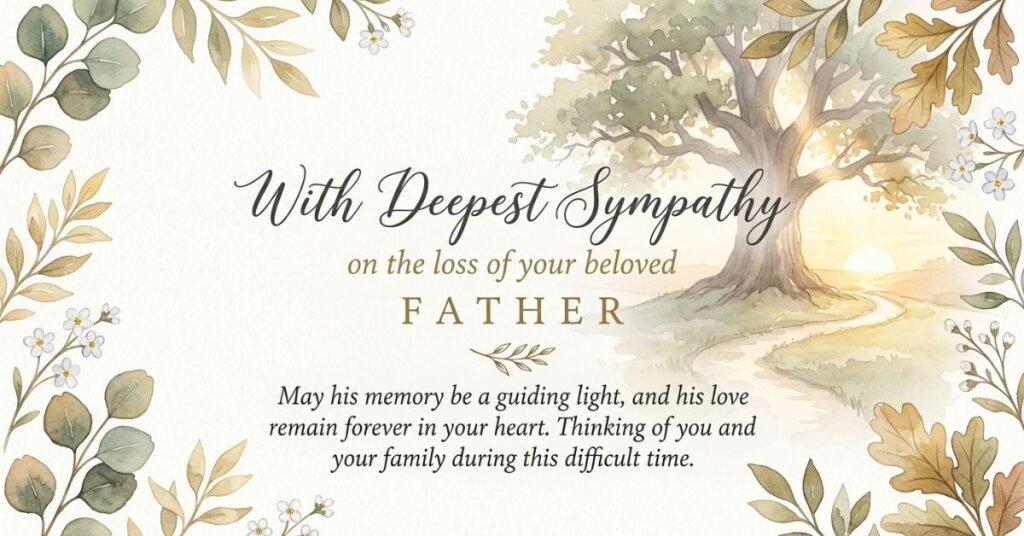
For someone who lost a father
- “Your dad’s quiet strength showed in everything you do. He lives on through you.”
- “I’m so sorry about your father. I hope you can feel how proud he was of you, even now.”
For someone who lost a grandparent
- “Grandparents are the keepers of our family stories. I’m sorry yours is gone, and I hope you’ll keep telling those stories.”
- “Your grandfather’s blessings will stay with you for your whole life.”
For someone who lost a close friend
- “Friends like that only come along once. I’m so sorry. I’d love to hear your favorite stories about them whenever you’re ready.”
- “You were a wonderful friend to them, right to the end. They knew how much you cared.”
Messages to Say in Person or at the Funeral
Spoken words are often harder than written ones. Keep them short, warm, and unhurried. You do not need to fill the silence.
- “I’m so sorry for your loss.”
- “I’m here with you.”
- “He meant a lot to me. I’ll miss him.”
- “I came because I care about you, and I wanted you to know.”
- “I’m so glad I got to know her. She was special.”
- “Your family has been in my thoughts constantly.”
- “I don’t have the words, but I wanted to be here.”
- “I’ll always remember how kind he was to me.”
- “Please don’t feel you need to talk. I’ll sit with you for as long as you like.”
- “If you need anything at all, I’m just a call away. I’ll check in with you tomorrow.”
A gentle tip
A warm hug, a hand on the shoulder, or even a silent nod can say more than a full paragraph. Follow the person’s lead and respect their comfort level.
Condolence Messages from Groups, Schools and Communities
Organizations often send a joint message. These samples can be adapted for a school, workplace, neighborhood, or religious group.
From a school or university
- “The entire school community is deeply saddened by the loss of [Name], a beloved teacher whose patience inspired generations of students. Our thoughts and prayers are with the family.”
- “We are heartbroken to learn of the passing of our classmate [Name]. Our class stands with the family in grief and remembrance.”
From a team or department
- “Everyone in the [Department Name] team sends our deepest condolences. Please accept our love and support. We are covering things here so you can focus on your family.”
- “We were honored to work with [Name]. Their generosity and good humor will remain with us. Our hearts are with you.”
From a neighborhood or community group
- “Your neighbors and friends at [Community Name] are standing with your family in this difficult hour. We’ll be in touch to help in whatever way we can.”
- “The whole community mourns the passing of [Name], a kind soul who was always ready to help others. May their family find strength.”
From a religious community or congregation
- “Our congregation extends heartfelt sympathy to the family of [Name]. May God grant comfort and patience to all who loved them.”
- “Your brothers and sisters in faith are praying for you. Please let us bring meals and support in this time of need.”
From a sports club or hobby group
- “On and off the field, [Name] showed us what true teamwork means. We will miss their spirit, and we’re thinking of their family.”
Messages of Remembrance Addressed to the Departed
Some people find it comforting to write directly to the one they have lost. These messages can be used in a memorial book, a funeral program, a social media tribute, or a private letter.
- “You taught me patience without ever saying a word about it. Thank you for being my example.”
- “Every time I hear your favorite song, I feel you near. I’ll keep listening for you.”
- “The house is quieter now, but your laughter still echoes in my memory.”
- “I wish I’d said ‘thank you’ more often. I hope you knew. I hope you always knew.”
- “Rest well. You earned it. We’ll take care of each other for you.”
- “You gave so much to everyone, and asked for so little. We’ll keep your generosity alive.”
- “I’ll tell the next generation about you, so they can know the extraordinary person you were.”
- “I’m carrying your lessons with me every single day.”
- “Thank you for the stories, the meals, the prayers, and the hugs. You were the heart of our family.”
- “Until we meet again, I’ll live in a way that would make you proud.”
Messages for Grieving Children and Teenagers
Young people grieve differently from adults. Use simple, honest, caring words and avoid vague phrases like “went to sleep,” which can confuse children.

For younger children
- “I’m so sorry your grandpa died. It’s okay to feel sad or confused. You can ask me anything, anytime.”
- “Your mom loved you very, very much. That love will always be with you.”
- “It’s okay to cry, and it’s also okay to play. Both are normal.”
- “You didn’t do anything to cause this. Lots of people love you and will take care of you.”
For teenagers
- “I’m sorry about your dad. You don’t have to talk about it, but if you ever want to, I’ll listen without judgment.”
- “Whatever you feel right now, whether it’s sadness, anger, or nothing at all, it’s okay. I’m here for you.”
- “Losing someone this close is really hard. If you need a break from everything, tell me, and I’ll help make it happen.”
Messages for parents about their grieving children
- “I’m thinking of you and your children. If you need someone to take them to the park or bring them dinner, please let me know.”
- “I hope you’ll be gentle with yourself, too. Your kids are lucky to have you.”
Messages for Caregivers and Those Who Nursed the Departed
People who spent months or years caring for a sick relative often feel exhausted, guilty, and unseen. These messages honor their quiet work.
- “You gave her dignity, comfort, and love every single day. That was the greatest gift anyone could give.”
- “I saw how tirelessly you cared for him. I hope you can allow yourself to rest now.”
- “Whatever you wonder about now, please know you did far more than enough.”
- “Your devotion was extraordinary. Thank you for making her last days gentle.”
- “It’s normal to feel tired, relieved, and heartbroken all at once. All of it is okay.”
- “You were not just a caregiver. You were a source of love, and your loved one knew it.”
Messages That Honor Specific Qualities
When you can name a quality that made the departed special, your message becomes unforgettable. Use these as models and replace the quality with the one that fits.
For someone who was kind
“He had a way of making strangers feel like friends. I’ll remember his gentle manner forever.”
For someone with a great sense of humor
“There was never a dull moment around her. I’m smiling through tears as I remember her jokes.”
For someone who was generous
“He gave without ever keeping score. So many people are better off because of his kindness.”
For someone deeply faithful
“Her faith was the quiet backbone of everything she did. May her devotion be rewarded with peace.”
For someone hard-working
“He worked tirelessly for his family and never complained. He leaves behind a legacy of dignity and determination.”
For someone who was a great listener
“She always made time for me and truly listened. I never felt more heard than in her company.”
For someone adventurous
“He lived life fully and fearlessly. I’ll think of him every time I see a new horizon.”
For someone who loved cooking and hospitality
“Her table was always open to everyone. The warmth of her kitchen will live on in our memories.”
Messages When You Cannot Attend or Are Far Away
Sometimes distance, travel limits, or health keep us from being there. Your absence does not have to mean your support is absent.
- “I’m so sorry I can’t be there in person. Please know that my heart is with you, and I’ll call tonight to hear how you’re doing.”
- “I wish I could hold your hand through this. Until I can visit, I’m sending every bit of love I have.”
- “Please forgive my absence. I’ll be thinking of you during the prayers and ceremony. I’ll come as soon as I can.”
- “Though miles separate us, you’re right beside me in my thoughts. Let’s talk whenever you’d like.”
- “I’ve arranged for [food/flowers/a donation] to be sent as a small token of how much I care. It’s nothing compared to your loss, but I hope it brings a little comfort.”
- “I’d be honored to join the video call for the service. Please let me know the details.”
Messages of Encouragement for the Long Road of Grief
Grief doesn’t finish after a few weeks. These messages help in the months and years that follow, when the world has moved on and the pain has not.
- “I know it’s been a while and the world expects you to be ‘better.’ You don’t have to be. I’m still here.”
- “Some days will be easier, and some will knock you flat. Both are part of healing. I’m proud of you for getting through each one.”
- “Whenever you want to talk about them, I’ll always be glad to listen. You never have to worry about bringing them up.”
- “I hope today you can find one small thing that brings a smile, even if it’s just a memory.”
- “Grief takes courage. I admire the way you keep showing up for your life while honoring theirs.”
- “You don’t have to move on. You can move forward and carry them with you.”
- “If the next few weeks are hard, I’ll bring over soup and sit beside you. No talking needed.”
- “It’s okay to ask for help, and it’s okay to ask more than once.”
Gentle Replies When Someone Thanks You or Responds
After sending a message, you may receive a reply or a thank-you. Here are warm, low-pressure ways to respond.
- “You don’t need to thank me. I’m just glad to be here for you.”
- “Please don’t worry about replying. I’ll keep checking in.”
- “I’m happy to help in any way. Just say the word.”
- “It was my honor to know them. I’m sure I’ll be thinking about them for years.”
- “Thank you for telling me about them. I’d love to hear more whenever you feel like sharing.”
Fill-in-the-Blank Templates You Can Make Your Own
If you’re short on time or feeling stuck, use one of these templates and add your personal details in the brackets.
Template 1: Warm and personal “Dear [Name], I was so sorry to hear about the death of [Deceased’s Name]. I will always remember [specific memory or quality]. You and your family are in my thoughts, and I would like to [specific offer of help]. With love, [Your Name].”
Template 2: Brief and respectful “Dear [Name], please accept my sincere condolences on the loss of [Deceased’s Name]. Wishing you peace and strength. Sincerely, [Your Name].”
Template 3: Workplace “Dear [Name], on behalf of [Team/Company], I’m writing to express our deepest sympathy for the loss of your [relationship]. Please take whatever time you need. We’re thinking of you and your family.”
Template 4: Faith-based “Dear [Name], I was saddened to hear of [Deceased’s Name]’s passing. May [God/Allah/the Almighty] grant them peace and give you comfort and patience. You are in my prayers.”
Template 5: Long-distance “Dear [Name], I’m so sorry that I cannot be there with you. [Deceased’s Name] meant so much to me, especially because [reason]. I’ll call you on [day] to check in. Until then, I’m holding you close in my heart.”
Template 6: When you didn’t know the deceased “Dear [Name], I was very sorry to hear of the loss of [Deceased’s Name]. I know how important [he/she] was to you, and I’m thinking of you during this difficult time. I’m here if you need anything.”
Practical Ways to Support Someone Beyond Words
Sometimes the most comforting thing you can offer is not a sentence but an action. Consider the following.
- Bring food. Grieving families often forget to eat. Prepare a meal, send groceries, or arrange delivery.
- Handle small tasks. Offer to answer the phone, pick up relatives from the airport, or manage visitors.
- Help with practical matters. Documents, bills, and arrangements can overwhelm a family. If you are close enough, offer help sorting them.
- Look after children or pets. Giving the family a few hours of quiet is a real gift.
- Attend the funeral or prayer gathering. Your presence matters more than anything you could say.
- Listen without fixing. Let the person talk, repeat stories, or sit in silence.
- Check in regularly. A short message every week or two can be a lifeline.
- Support their health. Gently encourage rest, water, and food, without lecturing.
- Contribute to something meaningful. A donation, a planted tree, or a charitable act in the name of the deceased can be a lasting tribute, especially if it reflects their values.
Cultural Sensitivity in Offering Condolences
Mourning customs differ widely across cultures and faiths. A little awareness helps you avoid causing accidental offense.
- Timing. In some traditions, such as Islam and Judaism, burial takes place very quickly, so condolences and visits happen within days. In others, mourning rituals can last for weeks.
- Dress. White is the color of mourning in some cultures, black in others. Dress modestly and conservatively when attending a funeral if you are unsure.
- Gifts and flowers. Flowers are welcome in many cultures but may be inappropriate in others. Food is generally a safe and appreciated gesture, though dietary rules may apply.
- Expressions of emotion. Some families grieve openly and loudly, while others remain quiet and private. Respect their style without judgment.
- Religious language. Use phrases from a person’s faith only if you share it or are confident it will be welcome. Otherwise, choose universal expressions of sympathy.
- Visiting customs. In many South Asian and Middle Eastern communities, it is customary for neighbors and relatives to visit the family’s home and sit with them for several days. Follow the lead of the family.
When in doubt, simply ask a close relative or friend of the family what would be most appropriate.
Common Mistakes and How to Recover From Them
Even thoughtful people sometimes say the wrong thing. If that happens, do not panic.
If you said something insensitive
A short, sincere apology is enough: “I’m sorry, that came out wrong. I just want you to know how much I care.”
If you waited too long to reach out
It is never too late. Try: “I’ve been thinking of you for a while and I’m sorry it’s taken me so long to write. I’m so sorry for your loss, and I’m here whenever you want to talk.”
If you do not know what to say
Admit it honestly: “I don’t have the right words, but I want you to know I’m here for you.”
If the person does not reply
Do not take it personally. Grief is exhausting, and many people cannot respond for weeks. Your message was received and likely appreciated.
Also Read! Apology Message to My Love: How to Say Sorry From the Heart (With 100+ Original Messages and Wishes)
Frequently Asked Questions
How long should a condolence message be?
There is no required length. One or two sincere sentences can be perfect. Longer messages are suitable for close relationships, but they should never feel like an obligation.
Is it okay to send a condolence message by text?
Yes. Texting is widely accepted, especially for quick, immediate support. For very close relationships or formal situations, a call, card, or visit may feel more personal. A text can always be followed by one of these.
Should I mention how the person died?
Only if the family has already spoken about it openly. Otherwise, avoid asking for details.
What should I say if I did not know the deceased?
You can still offer sympathy to the person you know: “I’m so sorry for your loss. I didn’t have the chance to know [Name], but I know how much [he/she] meant to you.”
Is it appropriate to use religious phrases?
Yes, if you are confident that the family shares your faith or would appreciate it. When uncertain, choose general phrases like “thinking of you” and “wishing you peace.”
What if I cannot attend the funeral?
Send a message, call, or write a card explaining that you wish you could be there. Offer to visit or help at a later time.
Is it okay to talk about the deceased later on?
Absolutely. Most grieving people love hearing the name of their loved one and enjoy stories about them. Avoiding the name often feels more painful than mentioning it.
How do I comfort someone who does not want to talk?
Respect their space, but let them know you are available: “No need to respond. I’m here whenever you’re ready.” Then continue to check in gently from time to time.
Can I send flowers or a gift instead of a message?
Gifts are lovely, but a few sincere words alongside them make them more meaningful. Always check cultural and religious customs first.
Final Thoughts
Writing a condolence message may be one of the hardest small tasks we ever face, but it is also one of the most meaningful. You are not expected to say something profound, remove the pain, or explain why this happened. You are simply being asked to show up with a caring heart.
Remember the key principles:
- Be sincere rather than perfect.
- Be prompt, but know that late is better than never.
- Be specific in memories and in offers of help.
- Be gentle, avoiding clichés and instructions.
- Be consistent, continuing to care long after the funeral is over.
Grief is the price of love, and the way we respond to someone else’s grief is one of the purest expressions of that love. A few honest words, a warm hand, or a quiet presence can remind a grieving person that even in the darkest hour, they are surrounded by people who care.
If you are reading this because you are about to write to someone in mourning, take a breath, choose the message that feels closest to your heart, and make it your own. That small act of kindness will be remembered far longer than you imagine.
May every grieving heart find comfort, and may every lost loved one be remembered with love.

Pingback: Condolences for Loss of Mother: Messages & Support Guide